Use cases

Email verification policies for the teams that own outbound risk

One technical result can mean different things to Revenue Operations, SDR leadership, GTM engineering, and outbound agencies. Each team needs a clear acceptance rule before verified addresses move downstream.

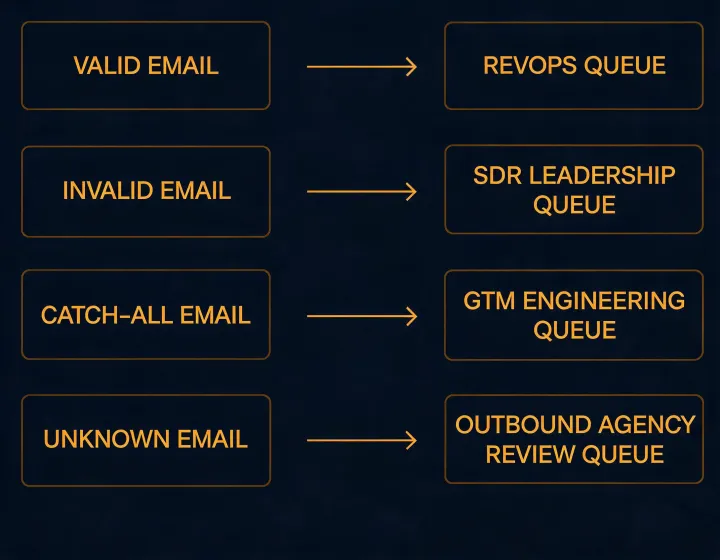
Email verification states routed to four revenue teams

Choose the decision owner

01

Revenue Operations

RevOps defines state mapping, freshness windows, suppression precedence, deduplication, CRM field ownership, and exception queues. A valid result can update a verification field, but it should not erase source, checked time, or a previous opt-out.

Acceptance question: Can every changed field be explained and reversed?

02

SDR and BDR teams

Representatives need a concise result that distinguishes mailbox risk from account relevance. Catch-all and unknown states should not be silently treated as verified, and a human should approve the contact, message context, and regional requirements before sending.

Acceptance question: Can the rep explain why this person and address belong in this campaign?

03

GTM Engineering

Engineers inspect package permissions, scoped secrets, provider responses, rate limits, retries, schema changes, logging, retention, and deletion. Testing begins with masked known examples in a non-production environment.

Acceptance question: Does the workflow fail safely without exposing credentials or upgrading uncertainty?

04

Outbound agencies

Agencies separate client policy, verification evidence, suppression lists, sender authentication, and approval records. Client data must not leak between workspaces, and a fresh verification result must never override a global or client-specific exclusion.

Acceptance question: Can the agency prove which policy and reviewer approved each handoff?
Technical requirements by operating context

RequirementRevOpsSDR leadershipGTM engineeringAgency
State definitionsField contractQueue guidanceSchema testClient policy
Checked timeStored timestampVisible in taskExpiry ruleCampaign window
SuppressionHard precedenceBefore sendIntegration testWorkspace isolated
Human reviewException ownerNamed approverRelease gateClient approval
DeliverabilityData hygieneSending limitsSPF/DKIM/DMARCPer-client monitoring

Bulk verification can reduce obvious address errors while increasing the number of records that require policy decisions. A single-source check is simpler to explain; a waterfall may resolve more candidates while adding cost, conflicts, and deletion work. Browser automation can be convenient but fragile; an API may be more repeatable but introduces credential, rate-limit, and schema dependencies. Select the method against the operational decision, not a universal accuracy claim.

Test the policy before the volume

Build a small cohort with known outcomes, ambiguous catch-all domains, prior suppressions, and stale records. Review every disagreement before expanding.

npx -y @okki-global/okki-go-taroball