Prepare the runtime
Record operating system, agent runtime, package version, and the exact stage under test. Use a non-production environment and masked professional addresses. Remove credentials and personal data from screenshots and logs.
Install and support
Record operating system, agent runtime, package version, and the exact stage under test. Use a non-production environment and masked professional addresses. Remove credentials and personal data from screenshots and logs.
List every external service the task may call and grant only the required scope. Store API keys in environment secrets, never in prompts, repositories, exported records, or shared logs.
Privacy · Terms · Research notes
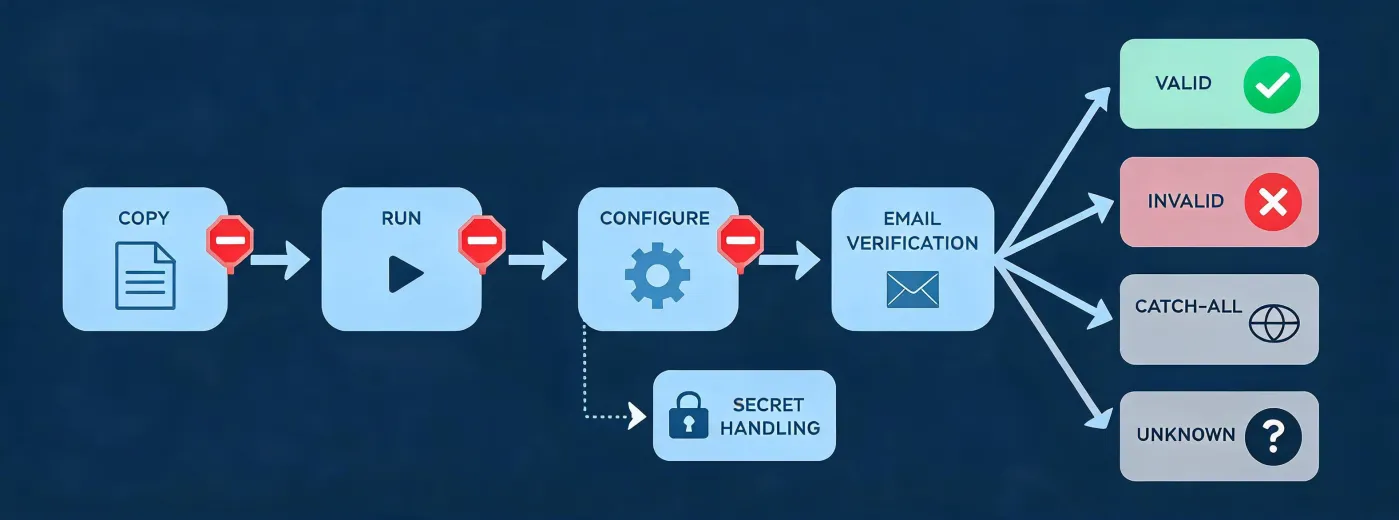
Confirm valid, invalid, catch-all, and unknown behavior with known examples. Keep provider, state, checked time, suppression status, and reviewer decision together.
npx -y @okki-global/okki-go-taroball
Copying changes only your clipboard. Review the package prompt before running. Configure credentials through a runtime secret store with minimum scope. Test known business addresses and keep outreach disconnected until verification state, checked time, provenance, relevance, suppression, and regional requirements pass review.
For a reproducible support request, record the package version, test date, operating system, runtime, sanitized error, and the smallest task that triggers it. State whether failure occurred while copying, running, configuring, or reviewing the first result.
Before configuration, list every external service the task may call and the minimum permission needed. Decide where intermediate company records are written, who can access them, how retries behave, and when temporary output is deleted. Do not reuse a production credential for an exploratory test.
Build the first task around masked business addresses whose valid, invalid, catch-all, disposable, and ambiguous states are already known. Include a prior suppression and a stale verification. This makes state mapping, retry behavior, and unsafe overrides visible without relying on an unknown benchmark.
After the run, separate installation health from research quality. A completed command shows that the package ran; it does not validate coverage or accuracy. A populated field shows that a source returned something; it does not establish freshness, lawful use, or commercial relevance. A draft message shows text generation; it does not authorize sending.
When connected outreach is later considered, establish SPF, DKIM, and DMARC health, suppression controls, opt-out handling, regional rules, sending limits, and a named human approver. Keep evidence supporting the account choice alongside the review record. No workflow can guarantee inbox placement, consent, replies, or fit.