State before score
Valid, invalid, catch-all, and unknown retain their plain meaning. Confidence never hides an unresolved provider response.
Integrations and operating story
NeverBounce begins at the point where a likely business address needs a defensible state. Its role is deliberately narrow: help an agent find or check an address, preserve the evidence, and hand the decision back to a person.

Why this scope matters
“Valid is a technical state, not a promise of delivery and never a substitute for relevance.”
Sales teams often assemble addresses from public domains, naming patterns, enrichment sources, previous CRM records, and manual research. Those inputs age at different speeds. They may refer to a former employer, an alias, a role mailbox, a catch-all domain, or an address that once worked but no longer does. A useful workflow keeps these distinctions visible instead of forcing every candidate into a binary pass or fail.
The NeverBounce operating model therefore separates discovery, verification, suppression, review, and sending. This separation helps RevOps investigate disagreements, helps SDR managers establish queue policy, and helps GTM engineers test data flow without granting an agent authority to contact anyone.
Valid, invalid, catch-all, and unknown retain their plain meaning. Confidence never hides an unresolved provider response.
Provider, check type, observed time, suppression status, and review decision travel with the record.
Relevance, lawful purpose, opt-out handling, authentication, and copy are reviewed outside the verification step.
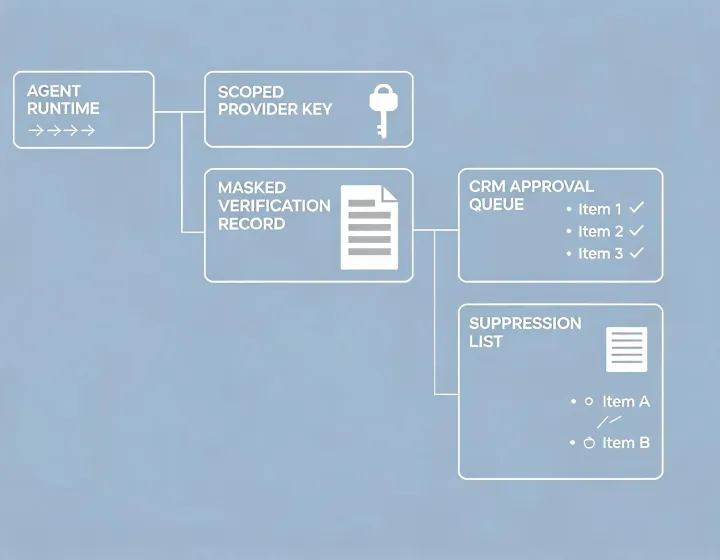
Integration boundaries
Input integrations may provide a company domain, a professional name, or an existing candidate address. Verification integrations may perform syntax, MX, disposable-domain, catch-all, or mailbox checks according to the provider’s documented behavior. Output integrations may receive an approved record in a CRM or controlled queue. Each connection should declare permission scope, owner, retry behavior, logging, retention, and deletion.
No decorative logo wall implies a commercial partnership. A connector is only “verified” after the operator tests authentication, schema, error handling, and the exact fields transferred in their environment. Planned or untested connections stay labeled accordingly.
Use masked examples to trace input, provider request, returned state, review decision, suppression, export, and deletion. Expand only when every handoff has an owner.
npx -y @okki-global/okki-go-taroball